


FAITH. DOUBT. SCIENCE. SPIRIT. HUMANITY

America didn’t stop believing.
It changed what it trusts.
That one shift… is the whole story.
For a long time, the church told itself a comfortable story. The story went like this: most Americans are Christian, the rest are atheists, and a few folks somewhere are Buddhist, Jewish, or Muslim. End of list. Pass the offering plate.
That story is broken.
Not damaged. Broken.
People are still looking for meaning. They just don’t always trust the old containers.
This series is about that. The whole thing. The whole messy, beautiful, complicated room. The people sitting next to you at work. Your cousin who burns sage and reads Marcus Aurelius. Your coworker who says she’s “spiritual, not religious.” Your neighbor who quotes the Qur’an. Your friend who left church and never looked back. The kid in your family who says, “I don’t know what I believe yet, and I’m okay with that.”
Welcome to Beyond the Pew.
Gloves stay off. Hearts stay open.
• • •
The receipts: what America actually looks like now
Pew Research just dropped its 2023–24 Religious Landscape Study. The numbers are not opinion. They are the room. Twenty-nine percent of U.S. adults are religiously unaffiliated. That is five percent atheist, six percent agnostic, and nineteen percent “nothing in particular.”
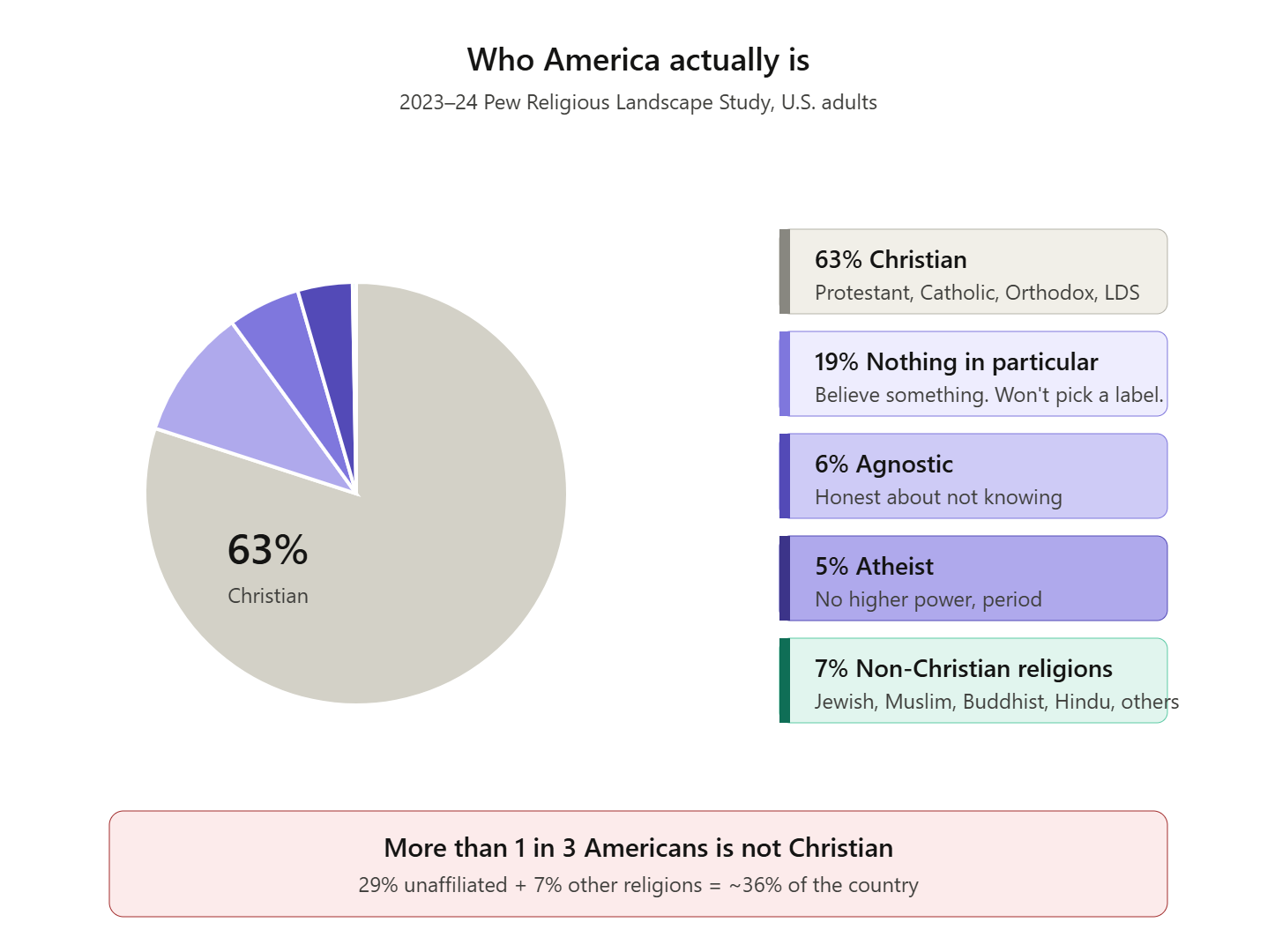
Seven percent belong to non-Christian religions. Two percent Jewish. One percent each Muslim, Buddhist, and Hindu. Stack that all together and roughly thirty-six percent of America is not Christian in any meaningful sense.
That’s more than one in three of your neighbors. More than one in three of the people who shop at your grocery store, sit on your jury, vote in your elections, and raise children in your school district.
And here’s the part that should stop you mid-scroll. Pew also found that seventy percent of U.S. adults still consider themselves spiritual in some way. Eighty-three percent believe people have a soul or spirit. Eighty-one percent say there is something spiritual beyond the natural world. Twenty-two percent describe themselves as spiritual but not religious.
Read that again.
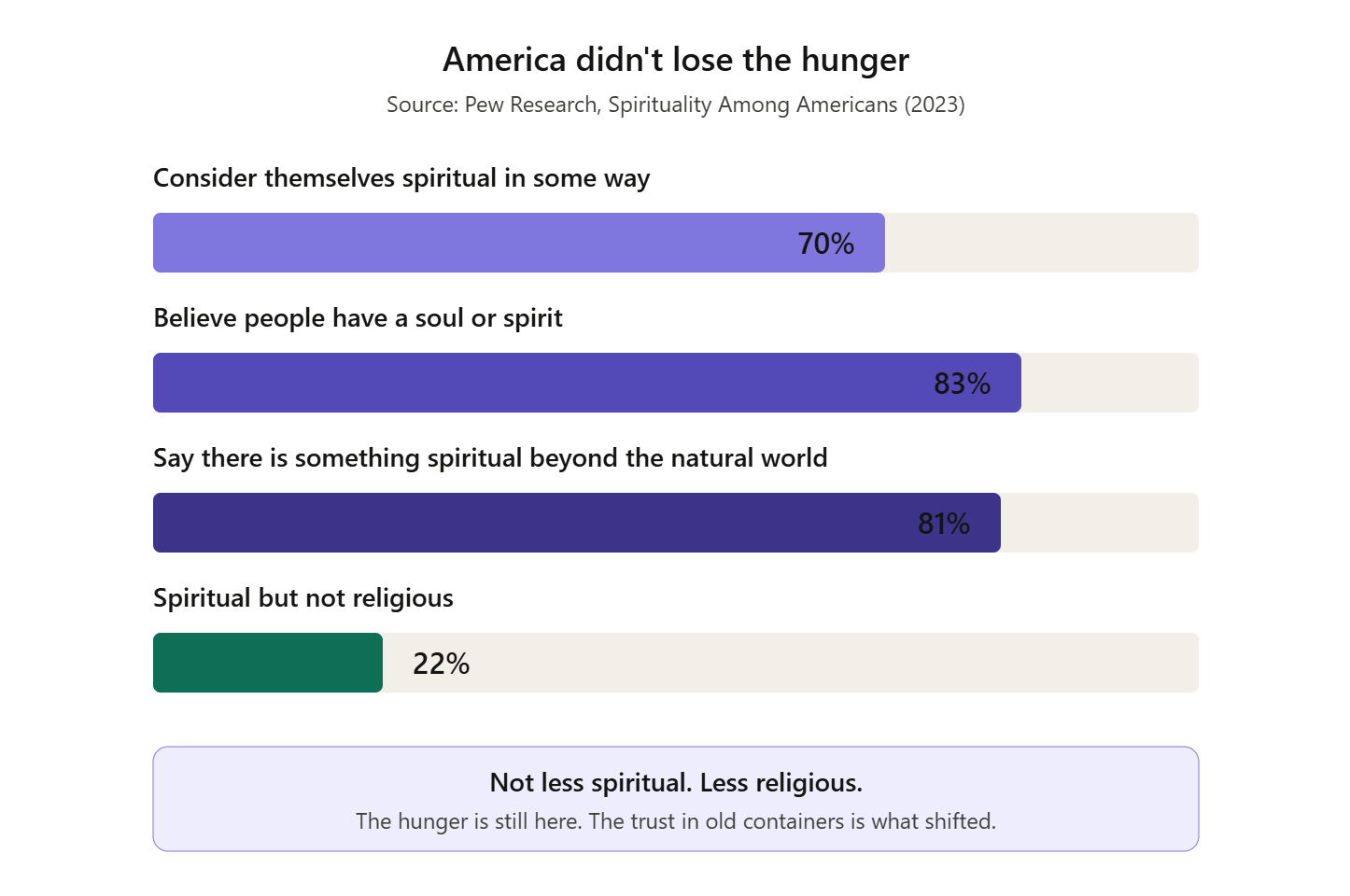
Not less spiritual. Less religious.
There is a difference. A big one. And if the church misses that difference, it will keep preaching to a room it doesn’t actually understand.
America didn’t lose its hunger for the sacred. It lost trust in the institutions that claimed to feed it.
• • •
Why “non-Christian worldviews” and not just “other religions”
Here is where most church teaching gets it wrong. We were trained to think the only options outside Christianity are other religions. Buddhist. Muslim. Hindu. Jewish. Like a buffet line of competing brands.
That framing is too small. And honestly, a little lazy.
Because most people walking away from church are not converting to anything. They are not becoming Buddhist monks. They are not running off to join a synagogue. They are doing something different. Something more American. Something more 2026.
They are building a worldview from scratch.
A little meditation here. A little science over there. Some Stoic philosophy from a podcast. A grandmother’s wisdom. A therapist’s reframe. A YouTube video on neuroplasticity. A trip to the ocean that felt holier than any sermon they ever heard. A funeral that broke something open. A church experience that broke something else.
They are not lost. They are looking. There is a difference.
So this series doesn’t just cover religions. It covers worldviews. The whole landscape. The way real Americans actually think, hope, doubt, grieve, and try to make sense of their lives in a country that is changing faster than most pulpits can keep up with.
• • •
The fifteen we’ll be sitting with
This is not a perfect rank by membership. Worldviews overlap. A person can be culturally Jewish, scientifically minded, spiritually curious, and morally humanist all before lunch. The list is survey-informed, ordered to move from the most familiar in everyday American life toward more specific traditions.
Here’s where we’re going.
Spiritual but Not Religious
Nothing in Particular / Religious Nones
Agnosticism
Atheism / Secular Naturalism
Secular Humanism
Judaism
Islam
Buddhism
Hinduism
New Age / Metaphysical Spirituality
Paganism / Wicca / Earth-Centered Spirituality
Unitarian Universalism
Sikhism
Bahá’í Faith
Indigenous / Native American Spiritual Worldviews
Some of these will surprise you. Some will challenge you. Some will make you mad. A few will probably make you say, “Well, I didn’t know that.” Good. That’s the point.
• • •
How we’re gonna do this
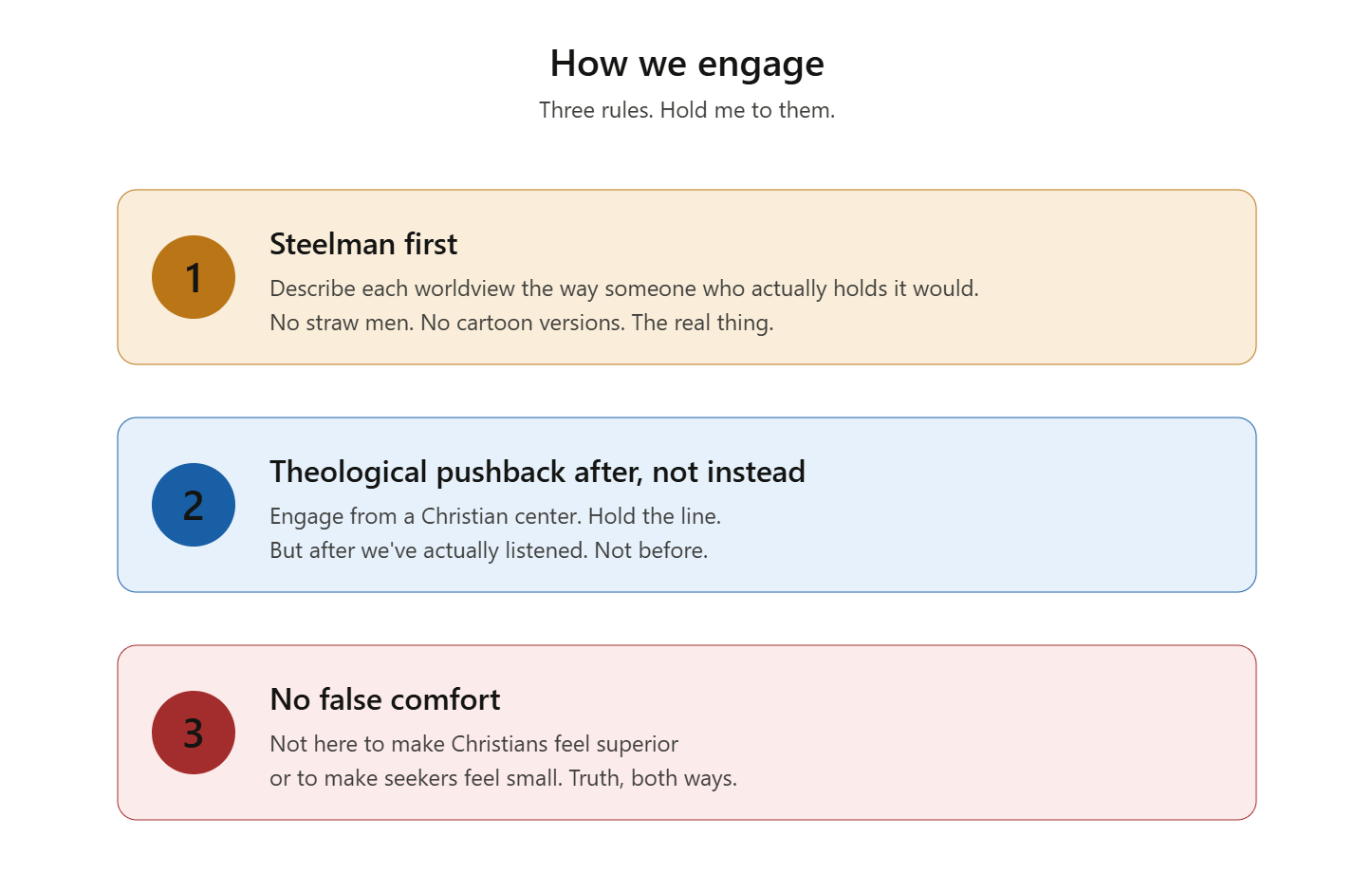
Three rules. I’m saying them out loud so you can hold me to them.
One. Steelman first. That is a fancy word for: I’m going to describe each worldview the way someone who actually holds it would describe it. Not the cartoon version. Not the “those crazy people over there” version. The real version. The version where, if a Buddhist or a humanist or a Wiccan read it, they would nod and say, “Yeah… that’s actually what I believe, and you said it better than I usually do.” That’s the bar.
Two. Theological pushback after, not instead. This is Gloves Off Theology, not Gloves Loaded Theology. We engage from a Christian center. We hold a clear theological line. But we do it after we have actually listened. Because anything less is not theology. It is just yelling with extra steps.
Three. No false comfort. We are not here to make Christians feel superior or to make seekers feel small. We are here to tell the truth about what people believe, why they believe it, and what the gospel actually has to say to all of it. Some of it will challenge them. Some of it will challenge us. Both can be true at the same time.
Genuine engagement is not weakness. It is the strongest move a serious theology can make.
• • •
Who this is for
This series is for the deconstructing Christian who isn’t sure what’s left when the building burns down.
It’s for the lifelong believer who is tired of pat answers and wants something with some real meat on the bone.
It’s for the curious agnostic, the cautious skeptic, the spiritual seeker, the bruised church kid, the Bible study leader who is starting to realize their material is forty years old, and the pastor who knows the room is changing but doesn’t have the bandwidth to read fifteen books to figure out how.
It’s for the parent whose teenager just said, “I don’t think I believe in any of this.” And the teenager who said it. And the grandmother who heard it and felt her stomach drop.
It’s for anyone who is tired of pretending the only choices are blind faith or blind unbelief. There is a wider room than that. And we are walking into it together.
• • •
A word about humility
Real talk. I am a Christian theologian. I have a clear conviction about who Jesus is and what the gospel is. That is not changing. If anything, this series will sharpen it.
But sharpening a conviction is not the same as broadcasting an opinion at a closed door.
I have sat across from atheists who quoted more Bible than some deacons. I have sat with Muslims who put my prayer life to shame. I have sat with “nothing in particular” folks whose moral compass made some Sunday school teachers look lost.
That doesn’t mean every worldview is equally true. It means every person is worth listening to before being preached at. Those are different sentences.
A theology that cannot listen is not a theology. It is a megaphone with a cross taped to it.
• • •
What you can expect from each episode
Every installment in this series will follow the same spirit but not the same skeleton. Different worldviews call for different shapes. Buddhism is a philosophy story. Indigenous spirituality is a survival and sovereignty story. Spiritual but Not Religious is a sociology story. Forcing all of them into the same template would flatten the very thing we are trying to honor.
That said, every episode will give you these things:
• A real, honest description of the worldview from the inside out
• The history, the sources, and the key voices that shape it
• The deepest, fairest version of why intelligent people actually hold this view
• The places where Christian theology agrees, where it differs, and where it stands its ground
• Practical wisdom for how to engage real people with real respect, not scripts
• Receipts: scholarly sources, primary texts, Pew data, named voices, no hand-waving
That last one is non-negotiable. We don’t do vibes around here. We do work.
• • •
Why this matters more than people think
Here is the part that should land heaviest.
If your neighbor’s worldview is invisible to you, you cannot love them well.
You can be polite. You can be friendly. You can wave from your driveway. But you cannot love them in any deep, biblical, ABIDE kind of way. Because you are loving a version of them you made up in your head. Not the actual person standing in front of you.
And the gospel was never designed to work on people we made up. It was designed for the actual room.
So this series is, at its core, a love letter. To the church, asking it to grow up. To the seeker, asking them to stay at the table a little longer. To the “nothing in particular,” the “spiritual but not religious,” the agnostic, the atheist, the Buddhist, the Muslim, the Wiccan, the Sikh, the Bahá’í, and the Indigenous wisdom-keeper. We see you. We are not afraid of you. And we are not coming to argue. We are coming to learn, and then to speak honestly. In that order.
Understand different. Engage deeply. Love boldly.
• • •
Where we go from here
Episode 1 drops next. We start where the cultural conversation is actually hottest: Spiritual but Not Religious. Twenty-two percent of America. Maybe more if you count the folks who haven’t found the words yet. The biggest unmarked door in the country. We’re going to walk through it together.
After that we keep moving. Fifteen worldviews. Real receipts. No fluff. No fear. Substack subscribers will get the long, deep, scholarly versions. The kind of work you can underline, save, and come back to.
BEFORE YOU GO
If this series matters to you, do three things.
Subscribe so you don’t miss an episode. The deep dives only live here.
Share this with one person who needs it. Not to convert them. Just to invite them to think.
Tell me in the comments which of the fifteen you most want to understand. I read everything.
This is going to be a long, honest conversation. I am glad you’re in it.
Beyond the pew, there is still a whole lot of God-shaped room left. Let’s go see what’s in it.
—Joe
ABIDE of NC | Gloves Off Theology | abide4us.com